BC Museums Week 2026
Museums Matter – From Awareness to Action
May 17 – 23, 2026 | #MuseumsMatterBC
For BC Museums Week 2026, the theme is “Museums Matter – From Awareness to Action”
 The BC Museums Association aims to empower the membership and the sector at large to tell the wider story of our collective impact. The BCMA will supply members with thematic questions to explore their essential role in B.C’s social and economic infrastructure. Let’s tell the story of why museums matter, and encourage supporters to advocate with us!
As museums, we preserve knowledge, strengthen communities, support reconciliation, and contribute to the economic vitality of our communities across the province. Despite widespread public support and positive impacts, museums remain chronically underfunded and under-supported by the government.
In provinces and territories across Canada, there have been sweeping budget cuts trimming arts, culture and heritage funding. In Nova Scotia, the heritage sector has been left reeling from unprecedented cuts (Halifax Examiner). The government has since spared half the museums originally expected to be cut, now to be run by community societies (CBC). New Brunswick has also seen fallout from the provincial budget, with heritage sites with fewer than 5,000 visitors cut from provincial funding (CBC). In Alberta, the Historical Society of Alberta has lost dedicated provincial funding, and significant cuts have been made to the provincial archaeological association and genealogical associations in the budget announcement (Chek News). Years of status quo budget support for the sector in British Columbia leave many questions for the future of arts, culture, and heritage.
While Canadians and all levels of government tighten their purse strings, charitable giving continues to decline. Our biggest supporters might not have the means to help us financially, but we need them to use their voices to support us now. Museums need help to ensure they survive and continue offering services and spaces to the next generation.
Join the BCMA during BC Museums Week and ask your staff and supporters to speak up for museums by engaging with our daily themes to start discussions in your communities about the needs museums meet in the community, and share your impact with local representatives.
Spread the Word!

For BC Museums Week 2026, BCMA is encouraging our members to join us in advocating for our sector.
How to Participate:
For each day of BC Museums Week, we have provided a concrete action you can take, with supporting information, images, and resources. Take part in this collective advocacy moment by:
- Clicking on the images to download
- Using any of the text and stats provided in your social media posts or letters to your representatives
- Using the hashtag #MuseumsMatterBC
Special Events & Highlights:
Monday
May 18
Museum Love Letters
Action: Encourage Your Visitors to Write a Love Letter to your Organization
On the statutory holiday, we ask our institutional members to engage their supporters and long-weekend visitors in writing a love letter to their organization.
Have visitors write a love letter using the downloadable postcard template. Display them at your organization, and consider mailing them to your local MLA when the week is over.
Did You Know…
According to a Generosity in Canada report, donations reported in tax filings are at their lowest level in 20 years. A Statistics Canada Survey on Giving found that only 1.2% of overall giving in Canada ($157 million out of $13.4 billion) went to arts and culture in 2023 (Hill Strategies). While Canadians are reducing their spending and financial support for non-profit museums, the regular funding the government provides has not kept pace with the number of requests it receives or with inflation. Volunteerism is down, and yet communities still rely on their local museums, art galleries and heritage sites for affordable family fun, school programs, camps, research, event space and for community connection. We need community members who love, support, and rely on the sector to use their voices now more than ever. Writing a love letter, tagging a post online, or contacting a political representative at any level is a helpful way to show support for your favourite arts, culture and heritage organizations.
Tuesday
May 19
Museums Matter to Communities
Action: Demonstrate Your Community Impact
How has your local museum, art gallery or heritage space served as a community hub this year?
Share your story online using the prompt “Our community museum creates space for…”. Tag the Provincial Ministers who might be interested in hearing how you help serve their goals.
If you operated as a cooling station during a heat wave, tag the BC Minister of Emergency Management and Climate Readiness alongside the BC Minister of Tourism, Arts, Culture and Sport. Check the Ministries list and/or the Ministers’ mandate letters to find a ministry that might be interested in how your museum helps the community outside of typical operations.
Did You Know…
Schools and teachers across the province and the country utilize museum education programs as valuable ways to engage students in learning and meet curriculum goals. Before the pandemic, museums saw year-over-year increases in school group attendance, and we expect that this momentum will have restarted post-pandemic when more recent Government of Canada Survey of Heritage Institutions data is released during BC Museums Week.
In a recent survey on youth learning environment and engagement in BC, participants were asked about activities outside of school. 18% of respondents wished they could be doing activities outside of school, and 27% wanted to be participating in more activities than they currently do. In response to a follow-up question about which extracurricular activities they wished they could do more of, 32% wanted to do more music and arts activities (drawing, painting, theatre, arts and crafts, singing), and 39% wanted to be learning new things like languages, coding or other skills (Youth Development Instrument, Dr. Hasina Samji, 2024).
Museums, art galleries, and heritage sites are spaces that serve educational purposes and are well-positioned to expand youth engagement activities, make tangible local connections to the curriculum, and provide low-cost spaces for community engagement. Most adults still recall a time in life when they visited a museum on a school trip!
As a ‘third space’ (outside of (1) home and (2) work), museums and related organizations serve an important psychological and social benefit to the community. Most museums offer a coffee shop, a gift shop for local shopping, community events that are free or low-cost, often with improved physical accessibility and opportunities for return visits or engagement. Susan Marie Ward argues in The Savy Museum Visitor that museums meet the criteria for being considered third spaces.
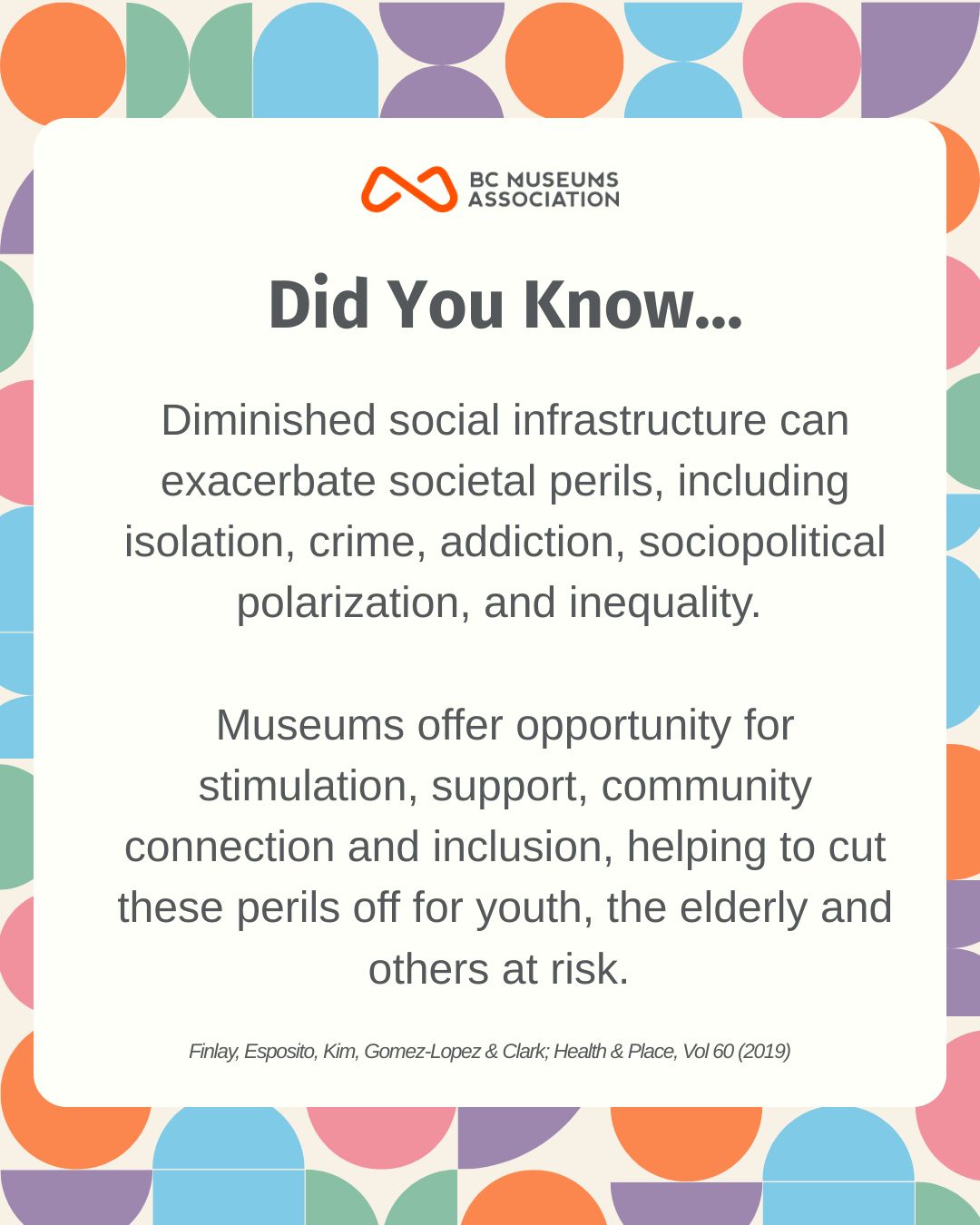
As a third space, museums also impact public health. As noted in an article published in Health Place in 2019, diminished social infrastructure can exacerbate societal perils, including isolation, crime, addiction, sociopolitical polarization, and inequality. Museums offer an opportunity for stimulation, support, community connection and inclusion, helping to cut these perils off for youth, the elderly and others at risk. This is especially true with museum spaces that offer free or low-cost admission.
Every community in B.C is unique, and the art, culture and heritage organizations within them reflect that uniqueness. Ask any organization how they fulfill community needs, and you’ll find a variety of answers – expected and unexpected! We are more than just arts, culture and heritage organizations – we are essential spaces that impact community health, wellness, social cohesion and education.
Wednesday
May 20
Museums Matter to the Economy
Action: Send a Letter to the Federal
and/or Provincial Government
If funding were available that reflected the importance of arts, culture and heritage, what is something your organization could do that has been put off due to a lack of funding?
Send a letter to the Provincial Minister of Tourism, Arts, Culture and Sport, and the Federal Minister of Canadian Identity and Culture, or to your local MP or MLA, to let them know what you could do with more financial support and how it would impact your community!
Event: Watercooler Wednesday
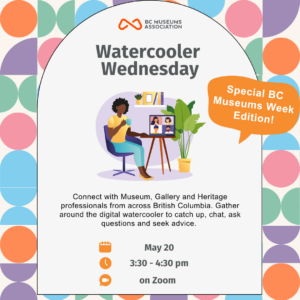
Join us to chat about advocacy at this week’s Watercooler Wednesday!
Wednesday, May 20 | 3:30 – 4:30 pm PT
on Zoom
Did You Know…
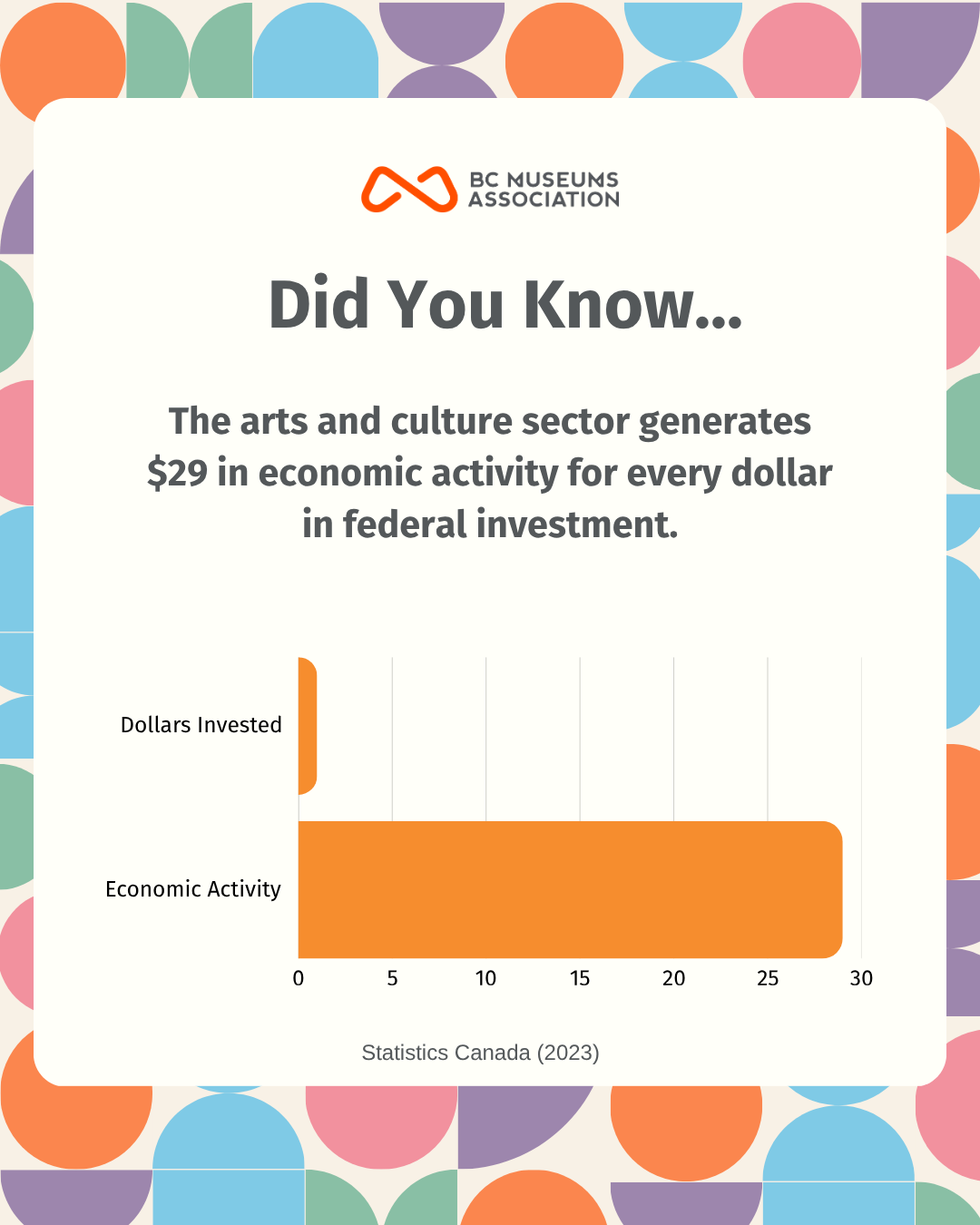
The Principal economist for the Canadian Chamber of Commerce, Andrew DiCapua, stated “the arts and culture sector generates $29 in economic activity for every dollar in federal investment – that’s an extraordinary return in addition to the social benefits that the sector generates”.
Data released in 2025 show the GDP of the culture sector increased in all provinces and territories in 2023 and outpaced the growth of the total economy GDP (StatsCan).
The direct contribution of BC’s culture industries to economy-wide GDP was estimated at $10.4 billion, or 2.7%. Sports in BC that same year were $1.3 billion or 0.4%. (StatsCan).
Not-for-profit heritage institutions in Canada generated approximately $3.1 billion in revenue in 2023, the highest level ever recorded for the sector, according to the most recent Government of Canada Survey of Heritage Institutions (2025). But when government grants are oversubscribed, the cost of supplies and wages is increasing, and funding cuts are looming, this is not enough to sustain the sector while heritage infrastructure ages and organizations struggle to survive.
The heritage sector in Canada employs approximately 36,670 people, an increase of 4,513 employees (14%) since 2020, when employment levels were considerably reduced due to the pandemic. According to the Canadian Chamber of Commerce, the arts and culture sector supports 13 jobs for every million dollars of output, which is more than oil and gas, manufacturing, or agriculture. Employment has largely rebounded to pre-pandemic levels, with overall workforce numbers now just 1.5% below those recorded in 2017 (Government of Canada Survey of Heritage Institutions, 2025). In BC, culture jobs made up 4.2% of the total economy jobs (StatsCan).
As stated by the Canadian Chamber of Commerce’s Business Data Lab:
“Despite these exceptional economic returns, funding challenges threaten the sector’s continued growth. With typical arts organizations relying on equal parts government grants, earned revenue and private donations, declining support from public and private sources creates significant pressure. The federal government’s allocation to arts, culture and heritage is declining as a share of total federal spending, while Canadian private contributions lag at 0.8% of income — below both North American (0.94%) and global (1.04%) averages.”
The Government loves to celebrate Canadian identity and culture, and the institutions that support it, when it benefits them in the news or as a host location for a symposium. But they fail to recognize that their lack of support each year will cost them more in the long term as costs increase and we become ever more important to their goals of creating a stronger, more united Canada and strengthening B.C.’s future.
Thursday
May 21
Museums Matter to the Future
Action: Revisit our BC Museums Week 2023
Podcast Series: Sto ries of Museum Impact.
Museums collect, protect, and interpret the objects and stories that help societies understand themselves. The decisions museums make today about what to collect and preserve, as well as who to partner with to tell stories, will shape how future generations understand our time.
If you could place something in a museum art gallery or heritage site for the citizens of your community 100 years from now, what would you donate? Share online using the #MuseumsMatterBC.
Did You Know…
90% of institutions surveyed by the Government of Canada Survey of Heritage Institutions partnered or collaborated with the communities they serve to help enhance programming, share expertise, and expand audience reach (2025). Nearly half of those institutions partnered with academic institutions, highlighting the sector’s important role in research and student learning.
When tools and funding support digital engagement,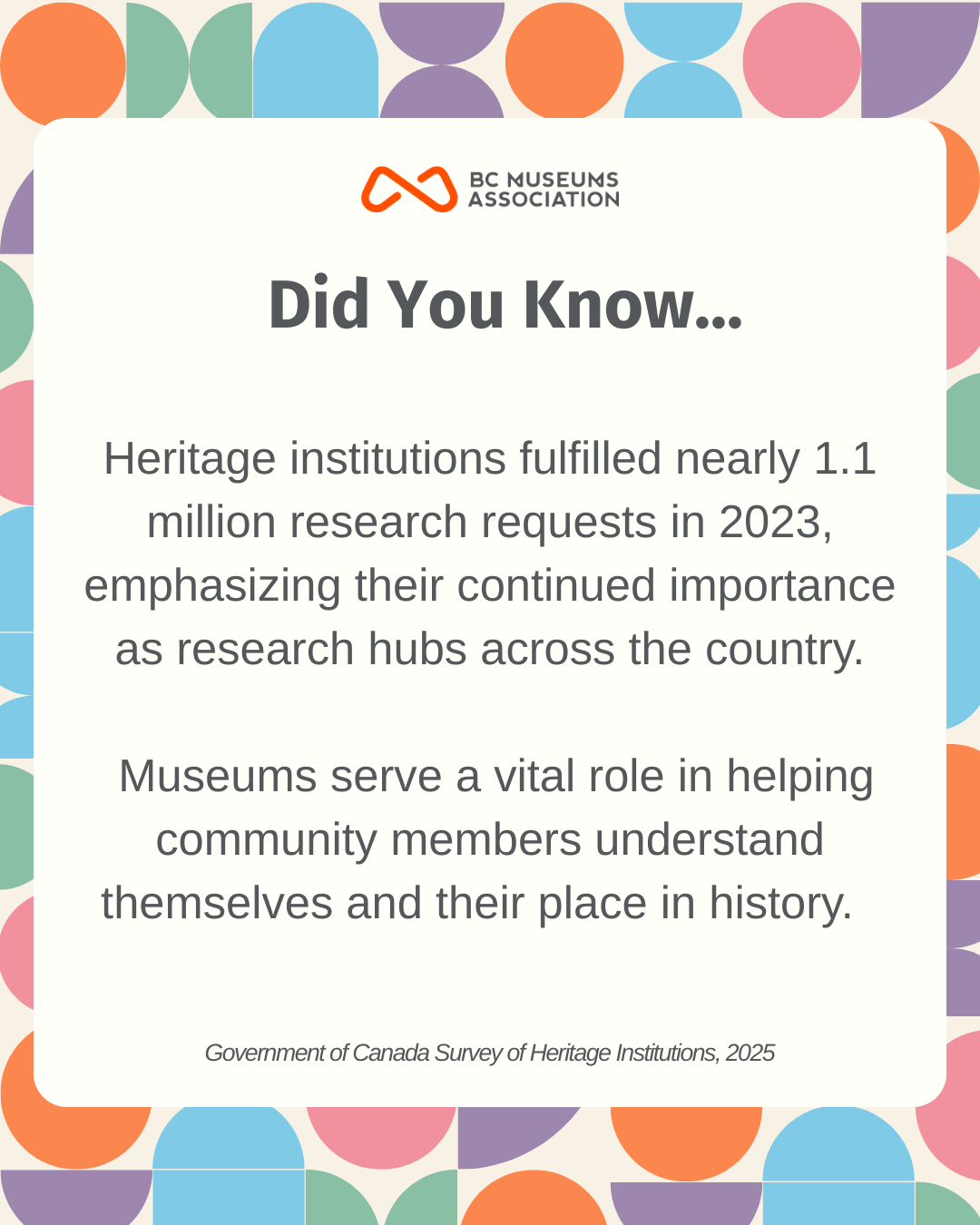 the benefits expand greatly beyond physical access. Heritage Institutions in Canada reported over 313.5 million online visits, the highest level ever recorded, and exceeding in-person attendance by nearly five to one, reinforcing the central role of digital platforms in extending reach and accessibility. (Government of Canada Survey of Heritage Institutions, 2025).
Alongside online engagement, heritage institutions fulfilled nearly 1.1 million research requests in 2023, emphasizing their continued importance as research hubs across the country (Government of Canada Survey of Heritage Institutions, 2025). This research ranges from genealogical searches to requests for archival information, research about an object held in a personal collection, among other things. Museums serve a vital role in helping community members understand themselves and their place in history.
Contrary to the belief that museums only hold old items, museums are constantly collecting, as space allows, to ensure that the narratives of our current generations are available for the future. Museums, art galleries and heritage sites are working tirelessly to document the present for the benefit of the future. Contemporary acquisitions, the documentation of major community events, and community storytelling are all methods used to ensure the continuity of the collections.
Friday
May 22
Museums Matter!
Action: Participate in Collective Advocacy
We ask all our members to share in this collective final day of advocacy by sharing whyMuseums Matter to you. Use the post and #MuseumsMatterBC to share online. If you are a member of the public passionate about your local museum, visit your favourite museum this weekend and bring a friend!
As we have been highlighting all week alongside our members and supporters, museums matter. Art galleries, heritage sites, museums, science centres, botanical gardens… all of these sites and others like them are working to support communities in as many ways as they can. They are integral to mapping and understanding our identity. The public and the government love their museums. Museums matter to communities. Museums matter to the economy. Museums matter to the future. There is no identity or community without the belonging and sense-making that museums work tirelessly to create and protect. If museums matter to you, we want you to share them with others and share why they matter to you!
Museums Matter: Why Do We Still Not Fund Them Like They Do?
Each year, the Select Standing Committee on Finance and Government Services holds a province-wide consultation on the next provincial budget and presents a final report with recommendations to the Legislative Assembly. Presenters are given five minutes to speak and five minutes to answer questions.
Here is what we recommended for Budget 2026: